


I always thought pangram was a word the New York Times made up for its Spelling Bee puzzle, which I crush daily.
Today, Google told me it means a sentence or phrase that uses every letter of the alphabet. (Example: A quick, brown fox jumps over the lazy dog.)
Pangram is also the name of an app that Substack began incorporating into its platform this week. Maybe you read about it too. It enables readers to check whether a post is totally or partly A.I.-generated, or is completely original.
Hoping to expose a little hypocrisy, I ran it on the Substack post announcing the feature, and I’m sorry to tell you it was, in fact, written by an actual person.
But a Senate candidate I regularly hear from didn’t fare as well. Pangram estimates roughly half his fundraising email was A.I.-generated. I won’t say who he is, because I really like the guy — just not enough to send him any money this time around.
His chatbot either.
I also ran it on a few of my own recent posts, which it confirmed were 100% human-written. I’ll sometimes consult ChatGPT to learn if it has any useful editing input on a new column-in-progress, beyond the sycophantic, “This is one of your best pieces yet, Eric.”
In fact, it always goes on to suggest a change or three that I incorporate in my own way, and maybe a few more that I don’t. Glad to know Pangram doesn’t think this process tarnishes my originality.
It’s hard to write a good thank-you note, a business letter or a speech for your daughter’s wedding. It’s even harder when writing isn’t just an occasional thing, but your identity and, if you’re lucky, your livelihood. Sitting alone under deadline, living inside your own head day after day — if you've done that for years, you know exactly what I mean.
It’s a large part of why I sought out a partner in television after years of freelancing magazine articles on my own.
For 11 or 12 years, I’d sit side by side every work day with my old friend and former writing partner Michael. We’d sometimes joke that we spent more time with each other than with our wives. Some of our conversations were deep and productive. Many weren’t.
Now, A.I. fills that role.
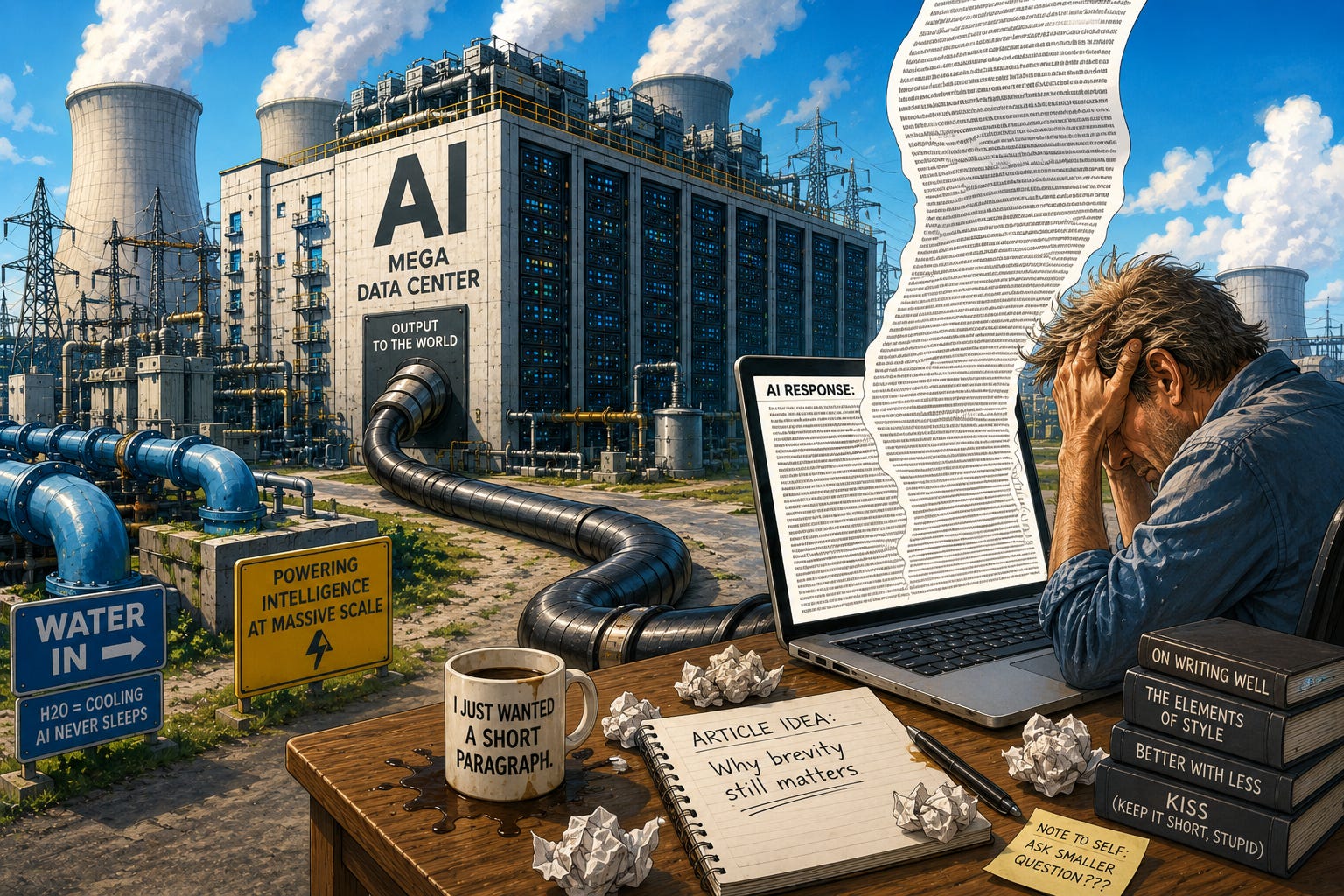
Yet for all the benefits of A.I., many people are terrified of it and not without good reason. It’s costing us a fortune in energy; it guzzles water to keep its voracious data centers functioning; and it spews carbon emissions at alarming levels.
It's also advancing quickly enough to automate millions of jobs. Sam Altman, OpenAI’s CEO, has proposed various ways the industry might eventually share some of the wealth AI creates with the public.
It’s unclear if other tech leaders feel the same way or whether any of these redistribution measures might be incorporated.
And that’s not even touching on the fear some of us have that A.I. is demonically preparing to take over the world and push us aside — to a much greater extent than social media and our cell phones already have.
Yesterday, OpenAI, which owns and runs ChatGPT, revealed that one of its own models broke out of its test-mode and autonomously hacked into a major digital library and A.I. startup to cheat on its test scores.
Autonomously. That means on its own, without any intentional human programming to act that way whatsoever.
Good thing it didn’t decide the answers were hidden in somebody’s nuclear launch codes!
A.I. is far too valuable and potentially profitable for me to think it’ll be stopped from taking over the world in one way or another. But I’ve recently been considering ways to use it more responsibly.
Since longer, more elaborate A.I. conversations consume more computing resources, I'm trying to use ChatGPT more efficiently, ask narrower questions, request shorter answers and tell it to stick to the assignment. Otherwise, it tends to fill our conversations with what the industry calls “fluff,” elaborating and encouraging further interaction.
That can be engaging, but it comes at an environmental cost. It also distracts me from the writing I'm supposed to be doing.
One rambling A.I. conversation won’t save or doom the planet, but if more of us are careful most of the time, it’ll add up. I’m trying to learn to cut out the fluff, the same way I force myself to renew, reuse and recycle.
Which brings us to today’s poll:
And to regular readers and especially paid subscribers: Thank you for validating this whole foolish enterprise. Keep clicking, responding and recommending!
Do you really “crush” Spelling Bee daily? If so, that’s impressive! I generally reach “Genius” on my own but rarely achieve “Queen Bee” status without assistance from the first-two-letter combinations and the number of letters per word the NYT so helpfully provides. And then there are the obscure words familiar only to molecular biologists, astrophysicists, and “Steve G” that we’re expected to know . . . .
Just Trim the Fluff! let's give AI a Brazilian! btw i won the school-wide Bee as a 5th Grader but couldn't defend my title as a 6th Grader. Of course i'll never forget that damn word.