

Paradise lost
Last year's Palisades and Eaton Fires were devastating. But this one was worse.

In the quarter-century I lived in various homes around Los Angeles, I never worried too much about the threat of wildfires. I’d hear about them every year or two, but they never affected anyone I knew.
As a typical Westsider, I didn’t even spend time in the Valley unless I had to, much less the outlying, wildlife-urban interface areas where fires would sometimes erupt.
In 2004, my family and I moved to one of those areas in Ventura County. It’s one of the closer ones to L.A. with an excellent school district, lying a dozen or so miles through canyon roads to the other side of the Santa Monica Mountain foothills, Pepperdine University and Malibu.
The following year, the Topanga Fire broke out, spreading smoke and ash throughout our area, and we were briefly evacuated from our new home.
We’re lucky to have been driven out only one other time since then – for the Woolsey Fire in 2018. Thanks to firefighters’ hard work, our home survived intact, but the event damaged several properties in our neighborhood. Embers floated through the air for days, one of them landing undetected a couple of blocks away, where it ended up burning a house to the ground on an otherwise untouched street.
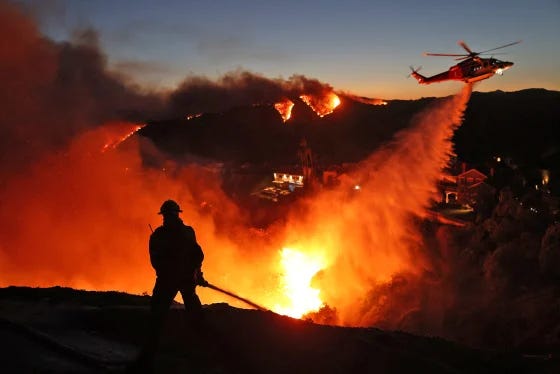
And then, of course, came last year’s Palisades and Eaton Fires, which we’ll all be hearing a lot about this week as their Jan. 7 anniversary approaches. It’s ironic that two of the most destructive fires in L.A. history came to Pacific Palisades on the Westside and to beautiful Altadena across town, two communities unbothered by large fires for decades, while my wife Linda and I were safely ensconced at home in fire country many miles away.
Between those two fires last year, maybe 30 people died and thousands of structures were destroyed, costing some $30 billion in real estate losses alone.
For people outside L.A., the numbers don’t begin to tell the story. And while those of us here may have a better understanding of the broad disruption, pain and fear last year’s fires caused, most of us, thankfully, still don’t know what it feels like to have to fight a raging, uncontrollable inferno or to flee from one as it destroys our immediate surroundings.
That’s what makes The Lost Bus, a film currently streaming on Apple TV+, truly remarkable. Directed and co-written by Paul Greengrass, who also helmed some of the Bourne films and the harrowing 9/11 docudrama, United 93, it stars Matthew McConaughey as the real-life school bus driver who volunteered to evacuate a bunch of kids through the devastating Camp Fire, which began the same day as Woolsey — Nov. 8, 2018 — and decimated the rural town of Paradise in a forested, hilly part of northern California.
Closely based on that historical event, McConaughey, as Kevin McKay, prevails upon a schoolteacher, Mary Ludwig (America Ferrera) to join him and help supervise the kids as he races his bus, in fits and starts, from a school their regular driver is unable to reach.
When the wind kicks up, the fires spread quickly, and falling trees block roads and bring down communication lines. Kevin is forced to create new routes through the blaze and the standstill traffic to bring everyone to safety, taking risks and breaking rules at every turn.
Frankly, I’ve never been a disaster-film kind of guy. Towering Inferno, Armageddon, The Poseidon Adventure — never seen ’em. I caught Twister in 1996, and from what I recall, it featured a couple of mid-level movie stars rekindling their relationship amid a bunch of by-the-numbers special effects.
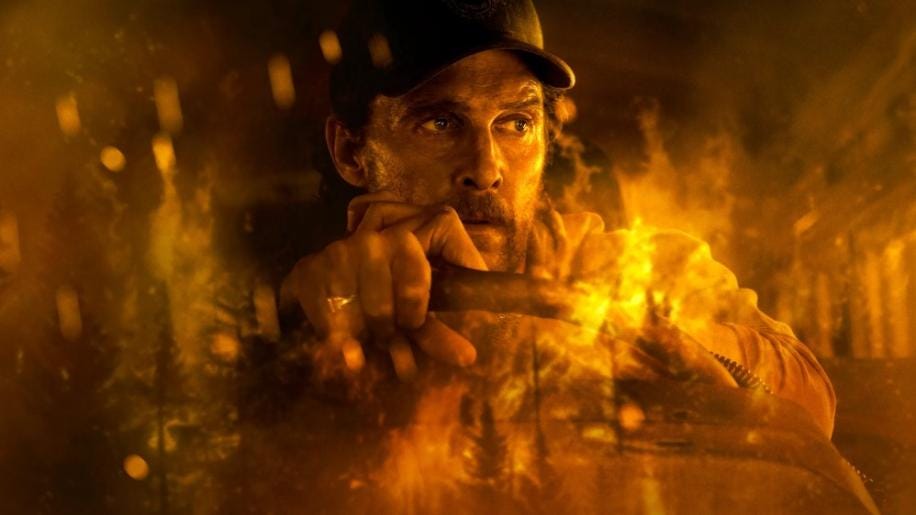
But The Lost Bus, expertly written by Brad Ingelsby (HBO’s Task), Greengrass and Lizzie Johnson, is a docudrama with minimal Hollywood glitz. The adult leads don’t fall in love. Their personal stories are quickly established, thoroughly believable and non-intrusive.
The story calls out but doesn’t dwell on its villain, PG&E, the utility company that later declared bankruptcy after accepting blame for its poorly maintained electrical transmission lines causing the fire. It doesn’t even explicitly mention climate-change, which increases the likely occurrence of such calamities. Instead, we’re viscerally focused on this one unfolding natural disaster, seeing how it happened and what went on behind the scenes when fire officials worked hard to fight it but were forced to give up and concentrate instead on helping most people survive.
Using real-life fire footage from Paradise, along with carefully managed special effects — some computer-generated, some actually created with massive propane tanks — the filmmakers depict a hell that’s nothing like a Disneyland thrill-ride. The schoolkids brave or unfortunate enough to look out their windows see things that will scar them for life.
One year after the beginning of Southern California’s worst catastrophic event on record, Altadena and the Palisades are now only beginning to rebuild, their character changed forever. The Lost Bus shows us how some people in Paradise endured a similar catastrophe.
Learning how to avoid it is another thing entirely.
We're going to watch it tonight. Thanks, Eric!
great article--I look forward to watching the movie. Wasn't aware of it.