

No kings
But if we have to have one, make it Mel Brooks

I want to tell you about the new Mel Books documentary and about some of my own experience with Brooks, but first: Minneapolis.
Make that the U.S.
We’re going through something bad in this country, but it’s also good in a way, because we’re starting to wake up and take action however we can.
I don’t have to go into details about our problems or about who’s causing most of them, because they’re bigger than a couple of murders in Minnesota, and they’re even bigger than you-know-who, although he’d tell you nothing and no one could be bigger than he is.
Can’t you just hear him? “A lot of people are saying I’m the greatest president of all time, and I’d have to agree, I am one of the greatest, probably the greatest president. I mean, you could go back to Abraham Lincoln, but Lincoln had the Civil War.
“That was a bad thing, the Civil War. A lot of people died in that war. Good people on both sides. We haven’t had a Civil War since I’ve been president. The radicals in the street, they might want a Civil War, but we’re not gonna have one, because we’re getting rid of those people who don’t follow the rules, and I make the rules.”
Actually, he might have said that last week. Then he started to back down like the demented TACO we’ve come to know. No more taking Greenland by force or threatening tariffs against countries that don’t support our territorial expansion. No more terminating FEMA disaster workers and pausing funding for public health.
And not as many cruel White House lies about the innocent people slain in cold blood by his ICE stormtroopers.
If there’s been a shift in tone at the White House — and there has — it’s because a groundswell of opposition has finally penetrated his bubble. He’s heard it from superstar athletes and movie stars; he’s heard it from world leaders and the billionaires in Davos; he’s heard it from the gun lobby.
And now he can hear it from The Boss, who just released a new anthem this week. It’s not exactly “Ohio,” but it’s something.

Until now I’ve been hearing throughout my household that nothing we do will ever have an impact on the president’s “thinking.” To be clear, my household currently consists of one person besides me, but she’s pretty smart and I’m sure she represents a lot of other Americans in her disillusionment.
I don’t want to understate how dire this time still is for U.S. democracy, but I believe we’re beginning to turn things around.
“It’s quid pro quo,” Mel Brooks says in Judd Apatow’s two-part, four-hour documentary, Mel Brooks: The 99 Year Old Man!, that premiered last week on Max. “You give them a little sweetness, you get it back.”
Brooks wasn’t talking about politics, but a philosophy of life that has carried him through more than 75 years as one of America’s foundational comedy giants. He’ll turn 100 on June 28.
We feel the sweetness throughout the show’s three-and-a-half hours, as Apatow interviews Brooks in detail about his life, his career and his defining need to make people laugh. Using that interview footage interspersed with clips from the movie classics Brooks wrote and directed, his many TV appearances, and heartfelt hosannas from an A-list of today’s leading comic minds, Part 1 establishes its subject as an emotionally needy jester with a scholar’s understanding of world history, a lightning-quick mind, and the delivery of a hyper-animated, mischievous child.
This first part effectively portrays Brooks’ early family life, his introduction to show business as a Borscht Belt tummler at age 14, and his rise to prominence improvising a stand-up routine with his new friend Carl Reiner when they worked as TV writers for Sid Caesar, alongside such others as Neil Simon, Larry Gelbart and Woody Allen. We also learn how he broke into the movie business by writing and directing audacious, groundbreaking comedies like The Producers and Blazing Saddles.
Part 2, which I actually preferred, spends time exploring Brooks’ long, loving relationship with Anne Bancroft, whom he met at a 1961 rehearsal for Perry Como’s TV show and began playfully pursuing with a true commitment that lasted throughout their 40+-year marriage until her death in 2005.
We also learn more about his abiding love for his family (all four of his adult kids and one grandchild are interviewed in the show) and for his longtime friend and comedy partner, Reiner. The two of them began ad libbing their 2,000 Year Old Man routine for each other and for friends in the early ’50s, with Carl playing the perfect straight-man and Mel spewing a rapid-fire array of Yiddish-inflected commentary about history’s most famous events, all of which he had purportedly witnessed.
For years, their improvisations were done only for small groups, until friends convinced them to cut a record, which earned their first of multiple Grammy Awards.
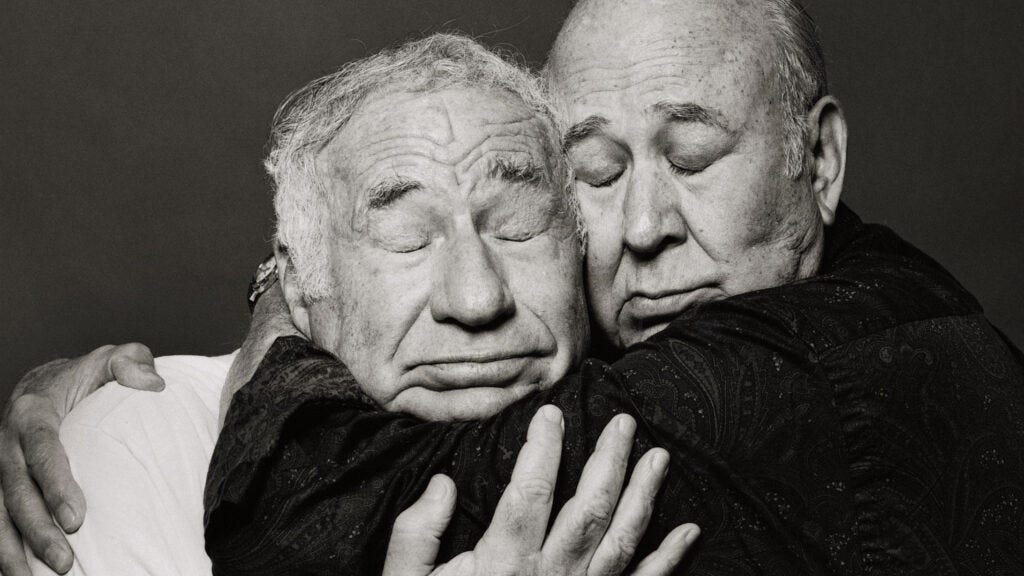
After many decades, Brooks and Reiner formed such a tight bond that when both their wives were gone, Mel would visit Carl pretty much every night, and they’d eat dinner off trays while sitting in front of the TV. Brooks was there the night Reiner, 98, collapsed in the bathroom of his home with a heart attack and died within minutes.
We hear from Carl’s son Rob Reiner that Brooks, to comfort himself, continued the same routine for months after Carl’s death, going to the newly empty house, having dinner in front of the TV.
Rob and his wife were tragically murdered shortly after the documentary wrapped production, so we’re spared the heartbreak over what his loss must have done to Mel.
I was lucky to be assigned to interview Brooks before the release of his 1981 movie, History of the World: Part I, for the now-defunct magazine insert Ampersand that was nationally distributed through college newspapers. I brought my friend Bill Braunstein along to take pictures, which he did when he wasn’t doubled over, crying with laughter.
What most impressed us, besides Mel’s comedic brilliance, was the way he seemed to treat us as longtime, casual friends. He even brought us into a screening room on the Fox lot to get our opinions on which reading of his soon-to-be famous line, “It’s good to be the king,” played best on screen.
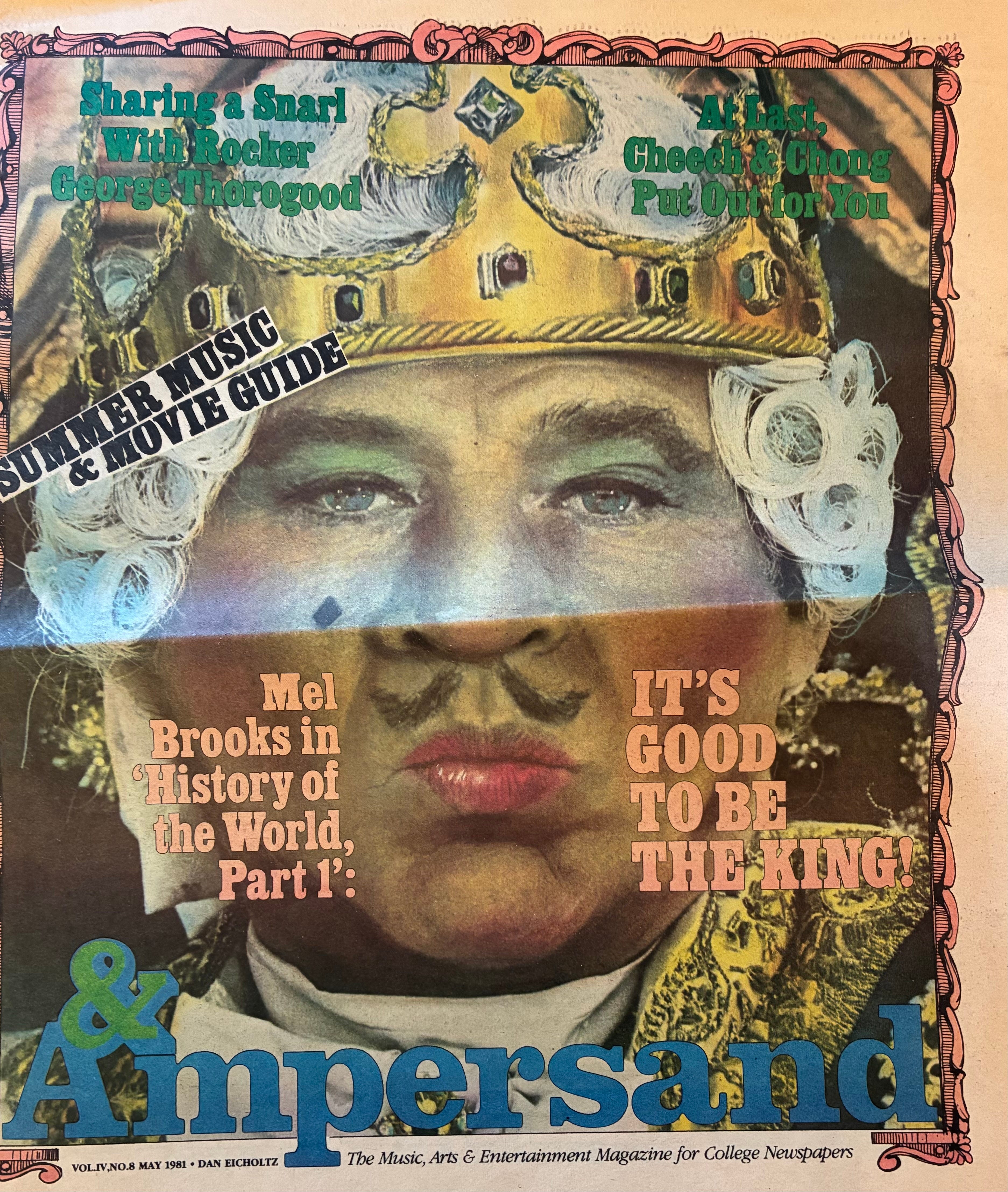
I had so much extra material from that interview, I decided to try to sell a separate Q-A elsewhere. Bill had thrown out some good straight-lines for Mel also, so we went in as partners on the project.
The trouble was, we were both pretty new in town and didn’t know many magazine editors. I did have contact info for someone at Oui, though, and he agreed to take a look. We were excited to find out he wanted to run it.
This was a big deal for us in the early stages of our careers, until I realized I owed it to Mel to get his permission for this maneuver. He had never agreed to be interviewed for Oui which, with its racy articles and nude photos, didn’t exactly appeal to his target audience. He politely asked us not to proceed.
So we reluctantly pulled back and sat on the piece for a while until we finally got it published in one of the in-flight, airline magazines. I was disheartened to have lost that sale to Oui, but from then on, Brooks always made himself available to me when I needed a phone interview or just a funny quote about something. Which was often.
The last time I saw him in person was in the early ’90s. I was a TV writer then and was going to pick up some scripts at the old William Morris agency in Beverly Hills. I had my very young son Adam with me, and we ran into Brooks, who was chatting with someone on the outside steps of the building. Mel gave us the warmest smile you can imagine and fussed over my son, as he congratulated me on starting a family.
You see that same smile running through the documentary. Comedy is Brooks’ great legacy, for sure. But so is the sweetness behind that smile.
This brings back some great memories. Of all the interviews I've done over the years as a journalist, the Brooks interview was one of the most memorable.
More great stories--love it! And you played the politics just right.